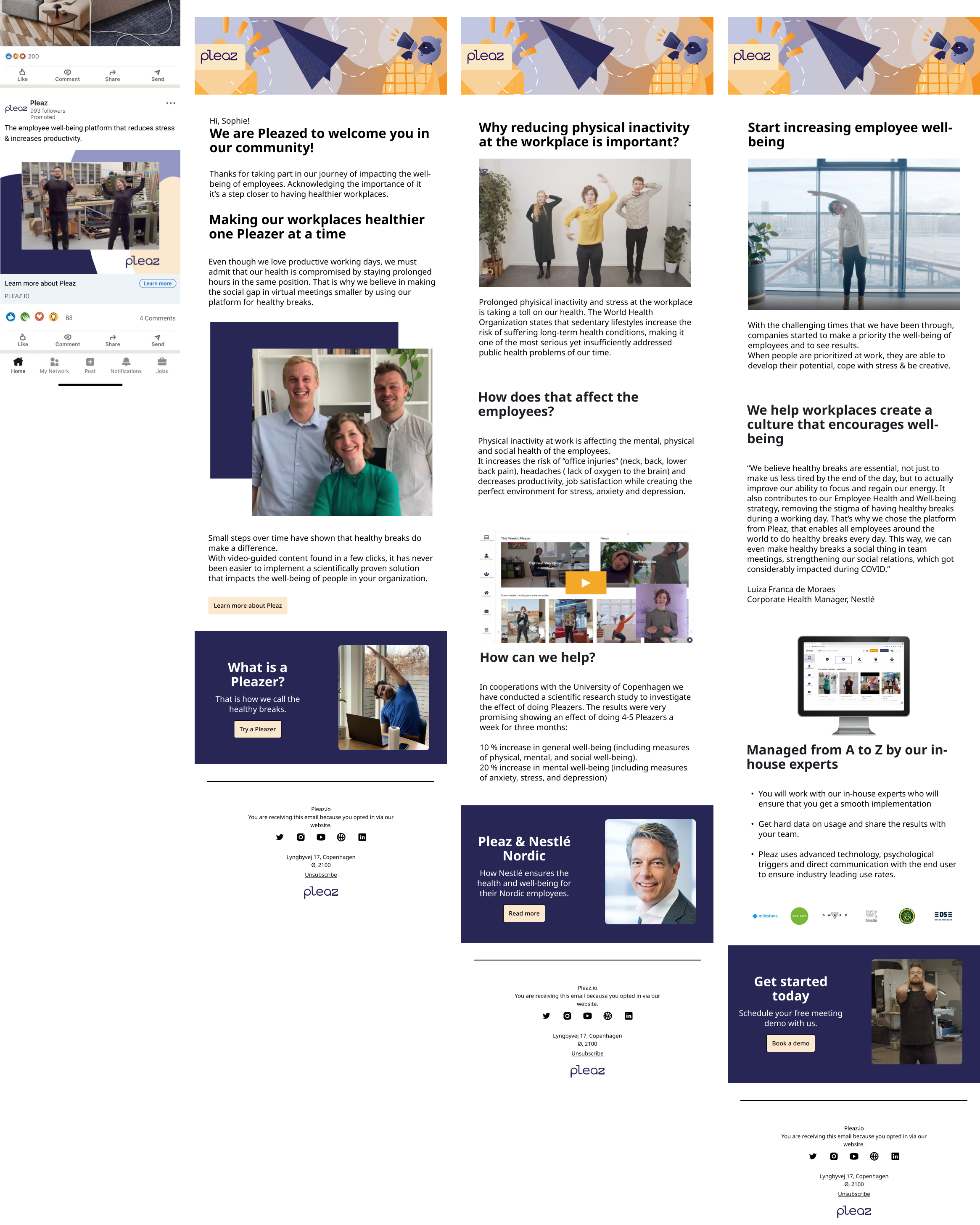
Part 1, LinkedIn: Prepare a LinkedIn ad to send traffic to our landing page.
The ad is set to communicate the who, what and how of the brand in a simple manner, in order to drive traffic.
I chose to use “single image” ad with the CTA redirecting to the landing page, to drive visits to the website/landing page. To measure its success, we will consider clicks. Using this CTA, the LinkedIn algorithm will push for getting as many clicks as possible, in order to reach our goal.
I chose to go with “single image” ad because these types of ads are getting a lot of views, as they blend in really well with organic posts in the feed.
The structure is simple and makes it easy to understand the “who, why, what”. Instead of saying “the employee platform that actually gets used”, I chose to go with “The employee well-being platform that reduces stress & increases productivity”, because it communicates directly the pain points that the platform is solving for the customer. “The platform that actually gets used” was not saying too much.
The post is aimed at companies with more than 500 employees.
I chose an image that reflects Pleaz and used brand elements to create consistency and be recognizable.
Part 2, LinkedIn: Write a sequence of three emails to potential customers to set up a demo meeting
The email flow is set to onboard, nurture and convert potential customers.
Email 1: In the first email, the potential customer is welcomed and introduced to the company/values are established. The user is welcomed by thanking and praising his choice of acknowledging the importance of well-being of employees, in order to create a “feel-good” mood. Then it’s introduced to company’s mission ( a bit about who, why and how) and in the end we share “what is a pleazer”, to get used with the terms from the very beginning and offer the opportunity to “Try a Pleazer” as a CTA.
Email 2: The second email has the scope of nurture/educate. We share why is important to reduce inactivity at the workplace, to show how we can come into the picture and help. We have the problem, how it’s affecting them and how can we help. At the end, as a CTA, we share how another company is handling this problem, to offer inspiration and to create trust, since Nestle is a big brand.
Email 3: The third email has the scope of getting conversions. We state the benefits and we let “others” say it better by introducing the testimonial from Nestle to strengthen the trust and share platform/process features. The CTA is “book a demo meeting”
How to measure success of sequence emails? Establishing a good conversion rate.
The emails are aimed at potential customers that are already interested/signed up.
I chose to balance the layout of the emails with pictures. The emails need to be visually pleasing to grow the reading rate. Besides that, I used brand elements that create consistency and a recognizable image.
Extra credit: Previously, I wrote the copy for the blog stories “Cruising on Copenhagen canals” & “Danish water-sports adventure” (some shots, edited, posted the content)